Uncategorized
Psychedelics for treatment resistant depression: are they game changers?

Aug
A New Chapter in the Treatment of Depression
Few areas of psychiatry have evolved as rapidly over the past decade as the treatment of treatment-resistant depression (TRD). Once limited primarily to medication switches and electroconvulsive therapy (ECT), clinicians now have access to an expanding array of evidence-based interventions, including transcranial magnetic stimulation (TMS), accelerated TMS protocols such as SAINT®, ketamine, intranasal esketamine, vagus nerve stimulation (VNS), and an increasingly robust portfolio of investigational therapies.
Among the most exciting developments is the resurgence of psychedelic-assisted therapies. After decades of limited scientific investigation, rigorous clinical trials are demonstrating that psychedelic compounds may produce rapid, meaningful, and sometimes durable improvements in patients whose depression has not responded to conventional treatments.
While these therapies remain investigational in the United States, their clinical development has accelerated dramatically. We may be witnessing the beginning of one of the most significant paradigm shifts in psychiatry since the introduction of modern antidepressants.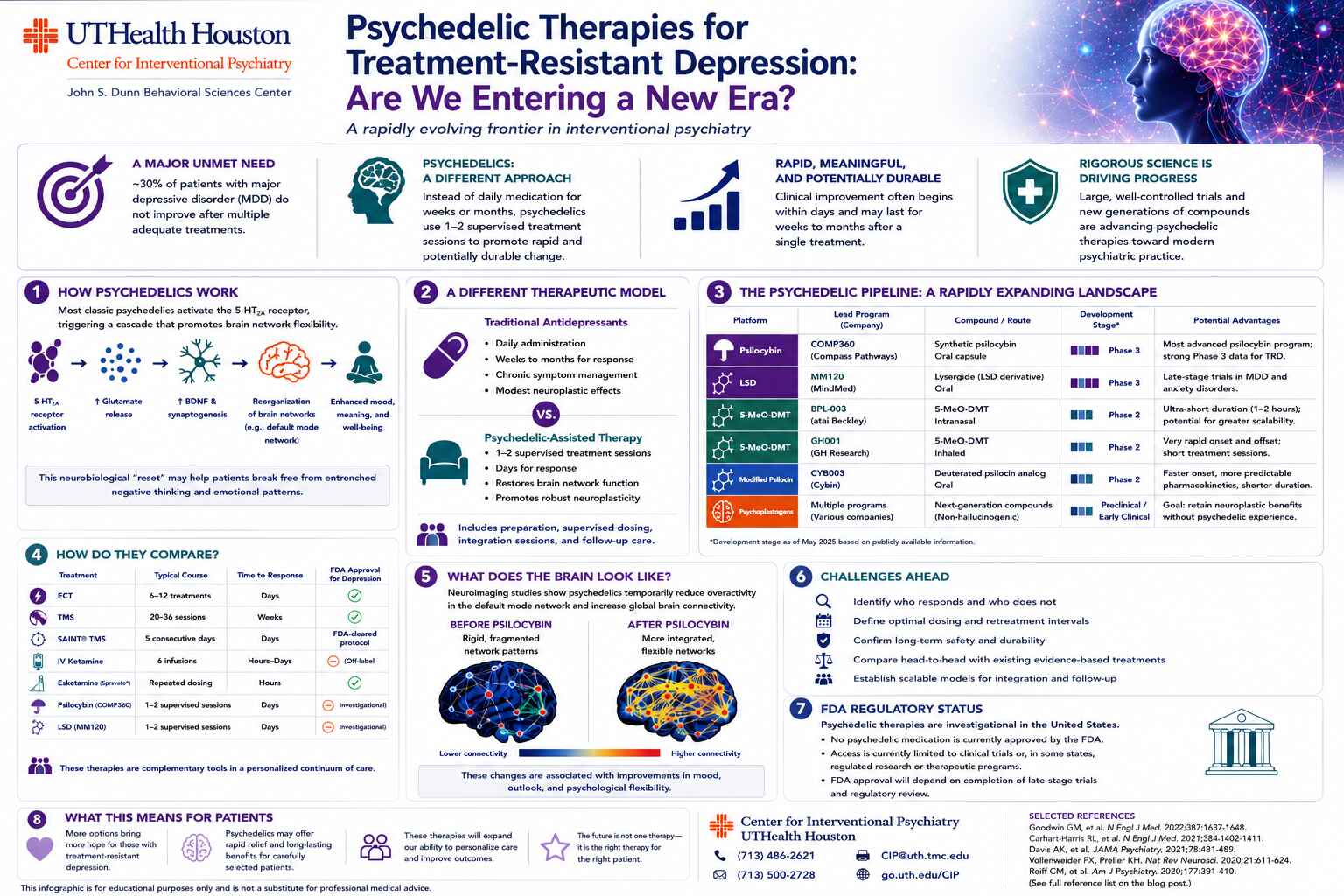
The Challenge of Treatment-Resistant Depression
Major depressive disorder affects more than 280 million people worldwide and remains one of the leading causes of disability.
Although conventional antidepressants have transformed psychiatric care, approximately 30% of patients fail to achieve adequate improvement despite multiple evidence-based treatments. These individuals are considered to have treatment-resistant depression (TRD).
Patients with TRD frequently experience:
- Persistent depressive symptoms
- Functional impairment
- Reduced quality of life
- Increased risk of hospitalization
- Greater risk of suicide
- Higher healthcare utilization
The need for novel therapeutic approaches has never been greater.
Why Psychedelics?
Classic psychedelics—including psilocybin, lysergic acid diethylamide (LSD), N, N-dimethyltryptamine (DMT), and 5-methoxy-N, N-dimethyltryptamine (5-MeO-DMT)—appear to work fundamentally differently from traditional antidepressants.
Rather than requiring daily administration over weeks or months, psychedelic therapies are administered during one or a small number of carefully supervised treatment sessions.
Clinical improvement often begins within days and, in some patients, may persist for weeks or even months after a single treatment.
This represents an entirely different therapeutic philosophy.
A Different Therapeutic Model
Traditional antidepressants generally work by chronically modifying monoamine neurotransmission.
Psychedelic therapies seek to produce rapid neurobiological change after a brief intervention.
Instead of continuous daily medication, treatment consists of:
- Careful patient selection
- Preparation sessions
- One or two supervised dosing sessions
- Structured psychological support
- Long-term integration and follow-up
This episodic model resembles other interventional psychiatric treatments such as:
- Electroconvulsive Therapy (ECT)
- Accelerated TMS (SAINT®)
- Ketamine infusion therapy
The objective is not simply temporary symptom suppression but the restoration of healthier brain network function.
How Do Psychedelics Work?
Although research continues, several biological mechanisms have emerged.
Most classic psychedelics primarily activate the serotonin 5-HT₂A receptor, initiating a cascade of downstream effects that include:
- Increased glutamatergic neurotransmission
- Enhanced synaptic plasticity
- Increased brain-derived neurotrophic factor (BDNF)
- Formation of new dendritic spines
- Strengthening of synaptic connectivity
- Increased cognitive flexibility
- Reorganization of dysfunctional brain networks
Neuroimaging studies suggest these compounds temporarily reduce excessive activity within the default mode network (DMN)—a network involved in self-referential thinking, rumination, and negative emotional processing.
This transient “reset” may help explain why many patients report profound changes in perspective, emotional processing, and psychological flexibility that extend well beyond the acute treatment experience.
COMP360: Leading the Field
Among psychedelic therapies currently in development, COMP360, a pharmaceutical-grade synthetic formulation of psilocybin developed by Compass Pathways, is the most advanced program for treatment-resistant depression.
COMP360 is administered as a single oral capsule under carefully controlled conditions with standardized psychological support before, during, and after treatment.
Its clinical development program has become the largest and most rigorous ever conducted for a psychedelic medicine.
Following encouraging Phase 2 studies, two pivotal Phase 3 clinical trials demonstrated statistically significant and clinically meaningful improvements in adults with treatment-resistant depression.
Several important observations have emerged:
- Improvement often begins within days.
- Many patients maintain clinical benefit for months.
- The treatment has demonstrated a favorable safety profile when administered in specialized clinical settings.
- Positive findings have now been replicated across multiple large clinical trials.
If approved by the U.S. Food and Drug Administration (FDA), COMP360 could become the first approved psilocybin-based therapy for treatment-resistant depression.
Beyond Psilocybin: A Rapidly Expanding Pipeline
Psilocybin represents only one component of an increasingly diverse developme
